Google and Yelp Must Require Evidence-Based Reviews
Customers have every right to criticize a business. Businesses should also have the right to present evidence when a review contains a false factual allegation.
That should not be controversial. Yet today, an unverified one-star rating can be posted in seconds and begin affecting a small business immediately. The reviewer may use a nickname, a name the business cannot connect to an order, or a nearly empty profile. The business receiving the review may have photographs, order records, delivery confirmation, product counts, timestamps, and correspondence proving that the allegation is inaccurate—but no meaningful way to place that evidence before the public or obtain a serious review from the platform.
We believe the first requirement of any fair review system should be simple:
No review or star rating should affect a business’s public score until the platform has privately verified that a genuine customer interaction occurred.
The customer’s identity does not need to be displayed publicly. Google, Yelp, and other platforms could privately verify an order number, invoice, appointment, payment, delivery, service record, or another legitimate interaction. Anonymous speech and customer privacy can be protected without treating an entirely unverified accusation as established fact.
A Negative Opinion Is Not the Same as a False Factual Claim
A fair policy must distinguish between opinion and a statement that can be tested against evidence.
A customer is entitled to say that a product was not to their taste, that they disliked its style, or that they were unhappy with the service. A business may disagree, but those are personal judgments.
Claims that an order was short, never delivered, spoiled, contained the wrong products, or looked materially different when it left the business are different. Those are factual allegations. Order records, delivery scans, photographs, product counts, and messages may prove or disprove them.
When a platform publishes a factual allegation, the allegation should not become immune from the facts.
Why We Now Photograph Every Order
At 5280Flowers and our sister business, 5280Gourmet, we now photograph every floral arrangement and gift basket before it leaves our hands. We do this to maintain quality, document substitutions, help resolve legitimate concerns, and protect both the customer and our business.
That documentation matters because a photograph submitted later does not always tell the full story. Phone filters can change colors and contrast. Images can be cropped, selectively framed, or otherwise manipulated. Products can also be moved or removed after delivery.
This does not mean that every customer photograph is misleading. It means that a responsible review process should examine original files, timestamps, order documentation, and the complete sequence of events before deciding what happened.
One Documented Order Shows What Is Wrong With the System
In one 5280Flowers case, a customer ordered approximately 3,000 red rose petals. Because the quantity was unusual and we anticipated that an accurate count could become important, we carefully documented the order. The requested amount was sent, and we included additional petals.
A negative claim was nevertheless made about the quantity received. The review appeared under a name we could not connect to the order. Two more one-star ratings also appeared from profiles we could not identify, without any explanation that would allow us to investigate or correct a problem.
We had evidence. We had documentation. What we did not have was an effective process that required the evidence to be weighed before the ratings continued harming the business.
This is why one-line public responses are not an adequate remedy. A business should not have to reveal private order information in a public argument merely to defend itself. The platform already controls the review, the profile, the rating calculation, and the reporting process. It should provide a secure place for both sides to submit relevant records.
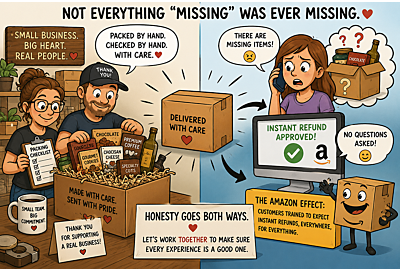
We have experienced the same imbalance at 5280Gourmet. In one dispute, the complaint concerned two pieces of cheese in a much larger basket. Approximately 95% of the basket consisted of shelf-stable products such as crackers, honey, fruit spreads, olives, and pickles. The cheeses had been individually packed with insulated cold packaging and sent using expedited shipping appropriate for perishable products.
We requested photographs of the allegedly spoiled cheese, but none were provided. There were also material inconsistencies in the timeline described to us: our documented call logs showed that the calls were made three days after the basket was received.
Even without photographic evidence, we were preparing one complete replacement basket containing two cheeses as a courtesy. Before it shipped, however, we discovered that the sender had already initiated a full chargeback through the card issuer without informing us, while still expecting the replacement basket to be sent at no charge. We would have lost the original payment and supplied an additional complete basket for free.
We submitted our call logs, order information, shipping records, and other documentation through the formal chargeback process. After conducting its own review, the card issuer ruled in our favor.
Yet the public review platform offered no comparable way to present that documented sequence to readers. Our willingness to resolve the complaint in good faith did not give us an effective opportunity to place the same evidence before the platform evaluating the review.
“That Sounds Like Something That Could Have Happened”
Years ago, I spoke with a Google representative about another review that we believed was fake. I still remember her response: “That sounds like something that could have happened.”
But it did not happen.
That distinction is the heart of this issue. A complaint sounding plausible is not proof that the event occurred. Almost any accusation can be written in a way that sounds possible. Evidence exists to distinguish what sounds possible from what actually happened.
A review platform should not decide a factual dispute based on whether a story could be true while disregarding records showing that it was not.
The Consequences Are Profoundly Unequal
Posting a false one-star review may cost the reviewer nothing more than a few seconds. The business receiving it may lose prospective customers, orders, revenue, staff time, and years of earned trust.
For a national corporation, one questionable rating may be an inconvenience. For a small local business, the damage can reach the owners, employees, suppliers, and families whose livelihoods depend on that business. A lower aggregate rating can remain visible long after the underlying accusation has been disputed.
The person making an unverified allegation should not receive every presumption while the business bears every consequence.
The Same Business Can Look Completely Different Across Review Platforms
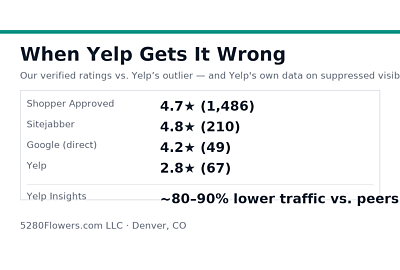
Our own ratings demonstrate why the review method matters. In a comparison documented on October 17, 2025, the same 5280Flowers business had dramatically different public scores across three platforms:
5280Flowers Review Comparison — October 17, 2025 Snapshot
| Platform | Rating | Review Count | Important Context |
|---|---|---|---|
| Shopper Approved | 4.7 / 5 | 1,486 | Feedback tied to verified customers and purchases |
| 4.2 / 5 | 49 | A completed purchase is not required before posting | |
| Yelp | 2.8 / 5 | 67 | Public-facing score shaped by Yelp’s recommendation system |
The table does not prove that every positive review is correct or that every negative review is false. It shows that verification, filtering, recommendation systems, and the number of reviews included can produce radically different portraits of the same business.
The largest collection—1,486 reviews tied to verified customers—showed a 4.7 rating, while Yelp’s much smaller public-facing sample showed 2.8.
Review totals change over time, which is why this comparison is presented as a dated snapshot. The underlying figures and additional context were published in our earlier article, When Yelp Gets It Wrong: Our Decade-Long Case for Fair Reviews.
The Platforms Already Acknowledge That Fake Reviews Are a Problem
Google’s Maps policies state that contributions should reflect genuine experiences and prohibit fake engagement, including content that is not based on a real experience or does not accurately represent the product or business.
However, Google’s published removal process says that when an initial report finds no violation, the business receives a one-time appeal.
Yelp says that people reporting a review should include information its moderators can independently verify. That is a sensible principle, but businesses need a transparent way to know whether their evidence was received, evaluated, or outweighed by something else. Read Yelp’s published content-moderation information.
The Federal Trade Commission’s Consumer Reviews and Testimonials Rule also recognizes that fake and false reviews distort the marketplace. The rule addresses reviews from people who do not exist, people who did not have actual experience with a business, and reviews that misrepresent the reviewer’s experience. Read the FTC’s official review-rule guidance.
Publishing rules against fake reviews is not enough. A policy has little value when a business cannot obtain a meaningful response, evidence is not seriously examined, or the case ends with an unexplained decision.
What a Fair Evidence-Based Review Policy Should Require
- Verify every interaction before publication. A review should not affect a public rating until the platform confirms a genuine purchase, appointment, delivery, service, or other interaction.
- Create a secure evidence portal. Customers and businesses should be able to submit order records, original photographs, timestamps, delivery confirmation, and relevant correspondence without publishing private information.
- Separate opinions from factual allegations. Opinions should remain protected. Disputed claims capable of objective proof should receive evidence-based review.
- Pause disputed ratings when credible evidence is submitted. The text can be labeled as disputed while it is investigated, but the rating should not continue affecting the aggregate score during a legitimate evidence review.
- Require human review for documented disputes. Automated screening can identify patterns, but a serious, transaction-specific appeal deserves evaluation by a trained person.
- Set and publish response deadlines. Reports should not disappear into an unresponsive system while the reputational damage continues.
- Explain every decision. The platform should confirm what evidence was received and identify the policy and reasoning that determined the outcome.
- Provide meaningful escalation. A one-time appeal is not sufficient when the decision ignores material evidence or apparent coordinated activity.
- Detect manipulated images and coordinated accounts. Platforms should examine original file data, device and account patterns, unusual timing, connected profiles, and repeated one-star activity when fraud is suspected.
- Impose consequences for proven abuse. Accounts used for fabricated transactions, coordinated attacks, manipulated evidence, or knowingly false factual claims should face removal and meaningful restrictions.
Verification Protects Honest Customers Too
A stricter system is not anti-consumer. It would make authentic reviews more trustworthy and more valuable.
Verified customers with legitimate complaints would have a stronger platform because their experiences would no longer be mixed with ratings from fake accounts, competitors, coordinated campaigns, or people who never interacted with the business.
Businesses would also have a greater incentive to document their work, respond thoughtfully, and correct genuine mistakes.
The goal should not be to remove negative reviews. The goal should be to protect truthful reviews—positive and negative—and remove content that is fake, coordinated, or contradicted by compelling evidence.
Google and Yelp Can Build a Fairer System
Google and Yelp have the technology, data, and resources to verify interactions while preserving customer privacy. They can identify patterns across accounts, confirm that evidence was received, distinguish opinions from factual disputes, and give small businesses a genuine opportunity to be heard.
What they should no longer do is publish an unverified allegation, amplify it through a permanent star rating, and leave the recipient of that allegation to absorb the damage while an opaque reporting system fails to respond.
Customers deserve the right to review businesses. Businesses deserve the right to evidence. The public deserves a system built on both.
This article reflects our firsthand experience and our proposal for improving online review systems. Individual examples have been anonymized to protect customer privacy. We welcome thoughtful discussion from customers, small-business owners, review platforms, consumer advocates, and policymakers.